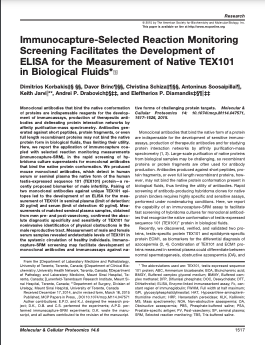
New Lab Test Brings Us Closer to Easier Male Fertility Diagnostics
Dr. Keith Jarvi has taken a big step forward in helping us understand a key male fertility protein called TEX101 — a protein linked to sperm production in the testicles.
In this study, they developed a special lab method to accurately detect TEX101 in real biological fluids (like semen and urine). Until now, it was hard to measure TEX101 in its natural state — and that made fertility testing less reliable.
Why this matters:
TEX101 is a potential biomarker for certain types of male infertility (especially when sperm production is the issue).
This research helps move toward creating a simple, dependable fertility test — using a small sample instead of a biopsy.
Their method also lays the foundation for future diagnostic tools that could be used in clinics.
In short: better tools = better answers = less guessing when it comes to male fertility.
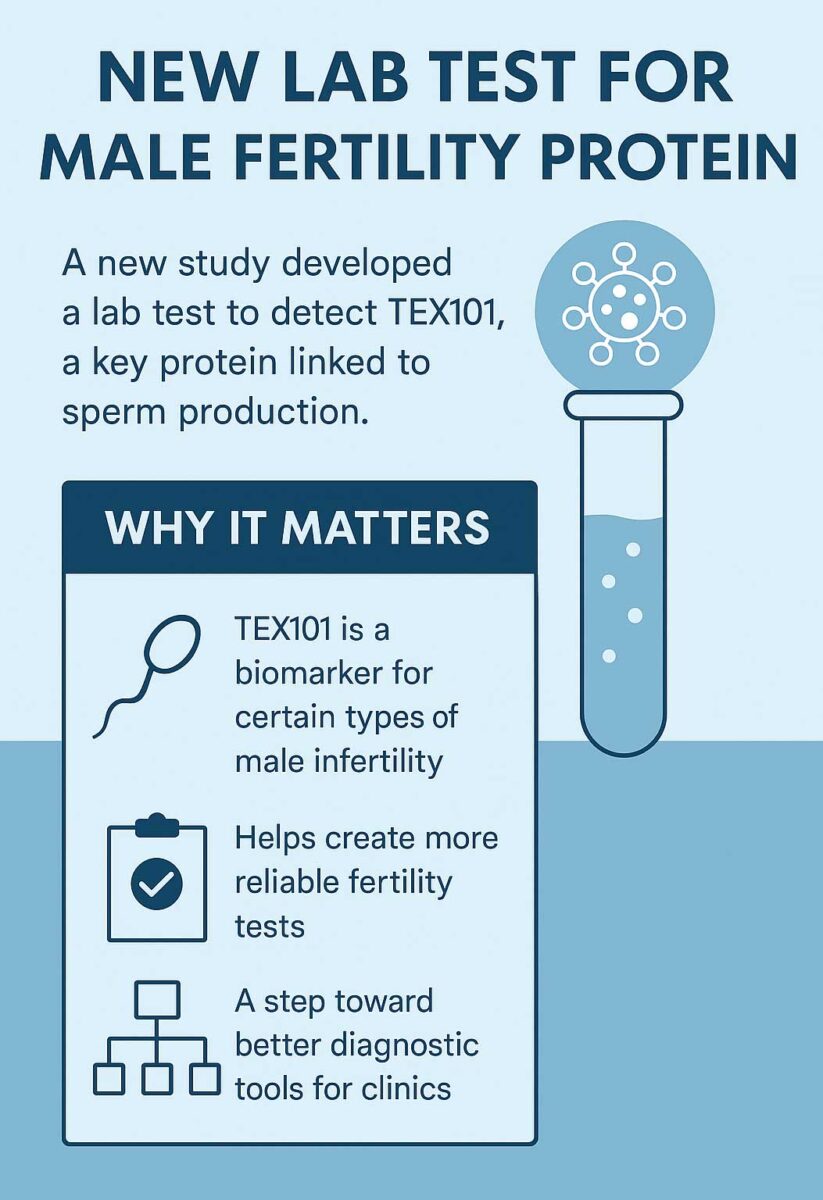
Monoclonal antibodies that bind the native conformation of proteins are indispensable reagents for the development of immunoassays, production of therapeutic antibodies and delineating protein interaction networks by affinity purification-mass spectrometry. Antibodies generated against short peptides, protein fragments, or even full length recombinant proteins may not bind the native protein form in biological fluids, thus limiting their utility.
Here, we report the application of immunocapture coupled with selected reaction monitoring measurements (immunocapture-SRM), in the rapid screening of hybridoma culture supernatants for monoclonal antibodies that bind the native protein conformation. We produced mouse monoclonal antibodies, which detect in human serum or seminal plasma the native form of the human testis-expressed sequence 101 (TEX101) protein-a recently proposed biomarker of male infertility.
Pairing of two monoclonal antibodies against unique TEX101 epitopes led to the development of an ELISA for the measurement of TEX101 in seminal plasma (limit of detection: 20 pg/ml) and serum (limit of detection: 40 pg/ml). Measurements of matched seminal plasma samples, obtained from men pre- and post-vasectomy, confirmed the absolute diagnostic specificity and sensitivity of TEX101 for noninvasive identification of physical obstructions in the male reproductive tract. Measurement of male and female serum samples revealed undetectable levels of TEX101 in the systemic circulation of healthy individuals. Immunocapture-SRM screening may facilitate development of monoclonal antibodies and immunoassays against native forms of challenging protein targets.
© 2015 by The American Society for Biochemistry and Molecular Biology, Inc.